
Insider Share Dealing, Donald Trump, Market Manipulation and Political Trading: Separating Fact from Speculation
- Iftekhar Khan

- Jun 4
- 7 min read
Financial markets thrive on information.
Every day, billions of pounds, dollars, and euros are exchanged based on what investors know, what they believe they know, and what they think others know.
The moment investors suspect that someone has access to information they don't, questions quickly arise.
Is this fair? Is it legal?
Is someone benefiting from an unfair advantage?
Recent headlines involving Donald Trump, substantial trading activity linked to trusts holding his assets, market-moving policy announcements, and unusual trading activity before major events have reignited a debate that sits at the intersection of politics, ethics, and financial markets.
But are these concerns evidence of insider trading?
Is this market manipulation?
Or are investors connecting dots that may not actually be connected?
Let's examine the facts.
Why This Matters
Financial markets depend on confidence.
Investors must believe that markets operate fairly and that everyone has access to the same information at the same time.
When confidence in that process breaks down, trust in the market can suffer.
This is why allegations of insider trading often attract significant public attention.
The issue becomes even more sensitive when the individuals involved hold positions capable of influencing government policy, regulation, taxation, trade agreements, or geopolitical decisions.
Few individuals possess more market-moving influence than the President of the United States.
What Is Insider Share Dealing?
One of the biggest misconceptions among investors is that insider share dealing is automatically illegal.
It is not.
Corporate insiders buy and sell shares in their own companies every day.
These insiders include:
Chief Executive Officers
Directors
Founders
Board members
Major shareholders
In most developed financial markets, these transactions must be disclosed publicly and are monitored by regulators.
There are numerous legitimate reasons why insiders sell shares.
Diversification
Many founders and executives have most of their wealth tied to one company.
Selling some shares simply reduces concentration risk.
Tax Obligations
Share awards frequently create tax liabilities that require liquidity.
Estate Planning
Trusts and family wealth structures often require asset transfers.
Major Purchases
Property purchases, business investments, and retirement planning may all require capital.
Pre-Planned Trading Programmes
Many executives establish formal trading programmes that automatically execute transactions months in advance.
For this reason, investors should be cautious about assuming every insider sale is a negative signal.
When Does Insider Trading Become Illegal?
Illegal insider trading occurs when someone trades using material non-public information.
The legal test is relatively straightforward.
The information must be:
Material
Capable of influencing an investor's decision or affecting market prices.
Non-Public
Unavailable to ordinary investors.
Examples include:
Unannounced takeover bids
Confidential earnings results
Major contract awards
Regulatory decisions
Significant corporate developments
Simply being an insider is not enough.
The individual must have access to confidential information and use it to gain an advantage in the market.
Proving this is often far more difficult than many people realise.
Regulators typically need evidence showing:
The information existed.
The individual had access to it.
The trade occurred because of that information.
A benefit was obtained.
This creates a high legal threshold.
What Is Market Manipulation?
Market manipulation is different from insider trading.
Instead of possessing confidential information, manipulation involves deliberately attempting to influence market prices through deceptive activity.
Examples include:
Pump-and-Dump Schemes
Artificially promoting an asset before selling into the resulting price increase.
False Rumours
Spreading misinformation to move prices.
Spoofing
Placing orders with no intention of executing them to create false supply or demand.
Wash Trading
Buying and selling between related parties to generate artificial volume.
A large share sale, even by a founder, billionaire, or politician, is not automatically market manipulation.
Evidence of deliberate intent is required.
Why Donald Trump Has Become Part of the Discussion
Recent financial disclosures revealed substantial trading activity associated with trusts holding assets connected to Donald Trump and his wider business interests.
Because Trump occupies one of the most influential political positions in the world, these disclosures attracted significant media attention.
Government policy decisions can directly affect:
Equity markets
Bond markets
Commodities
Energy prices
Cryptocurrencies
Entire industry sectors
Naturally, this creates questions.
Critics Argue
A president with significant financial interests faces potential conflicts of interest when policy decisions can influence asset prices.
Supporters Argue
Disclosure requirements exist precisely to provide transparency, and ownership alone is not evidence of wrongdoing.
Reports indicate that investment decisions are managed by third-party institutions and that Trump is not personally executing day-to-day trades.
This is an important distinction that is often omitted from sensational headlines.
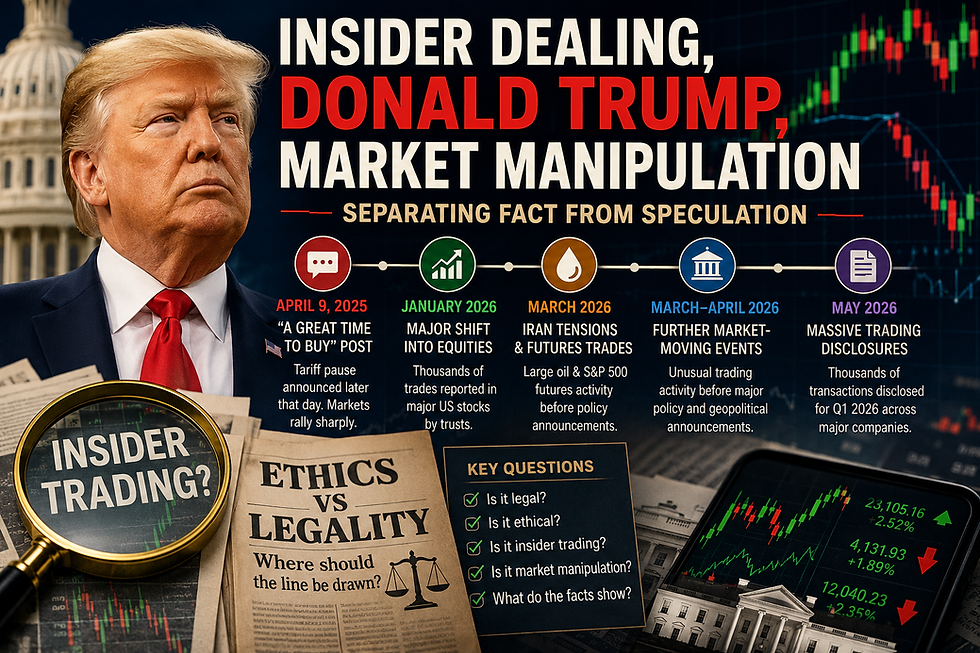
A Timeline of Recent Events
To understand why questions have been raised, it helps to look at the sequence of publicly reported events.
April 9, 2025
President Trump posted on social media:
"THIS IS A GREAT TIME TO BUY!!!"
Later that day, the administration announced a pause on certain tariffs.
Markets rallied sharply following the announcement.
The timing immediately attracted scrutiny.
Critics questioned whether anyone knew about the policy change beforehand.
No public evidence has emerged proving that Trump, family members, or administration officials traded using advance knowledge.
Throughout 2025
Financial disclosures indicated that trusts holding Trump's assets were primarily focused on municipal bonds and fixed-income securities.
Activity was relatively modest compared with what would follow.
January 2026
Disclosures later revealed a significant increase in trading activity.
Thousands of transactions were reported across major US equities.
Reported activity included exposure to large-cap companies including:
Nvidia
Apple
Oracle
Boeing
Broadcom
alongside reductions in several other major holdings.
The scale of activity attracted attention because it was unusually high for a trust associated with a sitting president.
March 2026
One of the most widely discussed events involved developments relating to Iran.
Reports suggested unusually large oil futures and equity futures positions were established shortly before market-moving announcements concerning military and diplomatic decisions.
Following the announcements, oil and equity markets reacted sharply.
The timing generated speculation regarding potential information leaks.
However, no public evidence has linked those trades to Trump, family members, or administration officials.
March-April 2026
Several additional market-moving announcements concerning trade, foreign policy, and geopolitical developments coincided with unusual market activity.
Again, commentators raised questions.
Again, no public findings established insider trading.
May 2026
Ethics filings revealed thousands of transactions executed during the first quarter of 2026.
The sheer scale of activity generated significant media coverage.
Critics questioned whether such active investment management should occur while occupying public office.
Supporters pointed out that the activity was disclosed and reportedly managed independently.
Have Any Laws Been Broken?
At the time of writing, there has been no legal finding that Donald Trump committed insider trading relating to these disclosures.
This distinction is critical.
There is a significant difference between:
Questions Being Raised
Public and media scrutiny.
Ethical Concerns
Debates regarding appropriateness.
Calls For Investigation
Requests for regulators to examine activity.
Evidence Of Wrongdoing
Proof that laws have been violated.
Legal Conviction
A formal finding by courts or regulators.
The existence of questions alone does not establish guilt.
Financial history contains many examples where unusual trading activity generated headlines but resulted in no regulatory action.
It also contains examples where investigations uncovered genuine wrongdoing.
Ethics Versus Legality
This is arguably where the real debate exists.
Many ethics experts believe senior government officials should place assets into fully blind trusts or divest from market-sensitive holdings entirely.
Their argument is simple.
Even if no wrongdoing occurs, public confidence can be damaged when decision-makers have financial interests potentially affected by their own policies.
Others argue that successful businesspeople should not be required to liquidate legitimate assets simply because they enter public service.
Reasonable people can disagree on where the line should be drawn.
Can Investors Follow Trump's Trades?
One question frequently asked is whether investors can simply follow Trump-related trading activity.
The answer is partly yes and partly no.
What Can Be Tracked?
Investors can monitor:
Presidential financial disclosures
Public ownership filings
SEC filings
Significant ownership changes
Transactions involving publicly traded companies
What Cannot Be Easily Tracked?
Investors generally cannot see:
Real-time trades
Private transactions
Brokerage account activity
Family trust transactions not subject to disclosure
Positions before disclosure deadlines
By the time many transactions become public, the opportunity to act may already be gone.
This is why "copy trading" politicians and insiders is often far more difficult than social media suggests.
What Research Tells Us About Insider Activity
Interestingly, research consistently suggests that insider buying is often more informative than insider selling.
Why?
Because insiders typically buy for one reason:
They believe the asset is undervalued.
People sell for many reasons:
Diversification
Taxes
Retirement planning
Property purchases
Estate planning
Family trusts
As a result, insider purchases often provide stronger signals than insider sales.
Lessons for Investors and Traders
Whether the discussion involves Donald Trump, members of Congress, CEOs, founders, or major shareholders, the same principles apply.
Follow Evidence
Separate allegations from proven facts.
Avoid Emotional Reactions
Markets often overreact to headlines.
Understand Context
A £20 million share sale may sound alarming until you discover the individual still owns £500 million worth of stock.
Focus on Process
Good investment decisions are rarely based on a single headline.
Maintain Risk Management
No news story should override a disciplined trading plan.
Final Thoughts
The recent attention surrounding Donald Trump's financial disclosures has reignited important conversations about insider dealing, transparency, political influence, and market integrity.
However, investors should be careful not to confuse suspicion with proof.
Insider share dealing is not automatically illegal.
Market manipulation requires evidence of deliberate attempts to distort prices.
Insider trading requires proof that trades were based on material non-public information.
At present, the discussion surrounding Trump's disclosures remains largely one of ethics, transparency, and public confidence rather than proven insider trading or market manipulation.
For traders and investors, the lesson is simple.
Investigate the facts.
Understand the context.
Follow the evidence.
And remember that disciplined analysis almost always outperforms emotional assumptions.
Educational content only. This article is provided for general information and discussion purposes and should not be considered investment advice, legal advice, or a recommendation to buy or sell any financial instrument.


Comments