
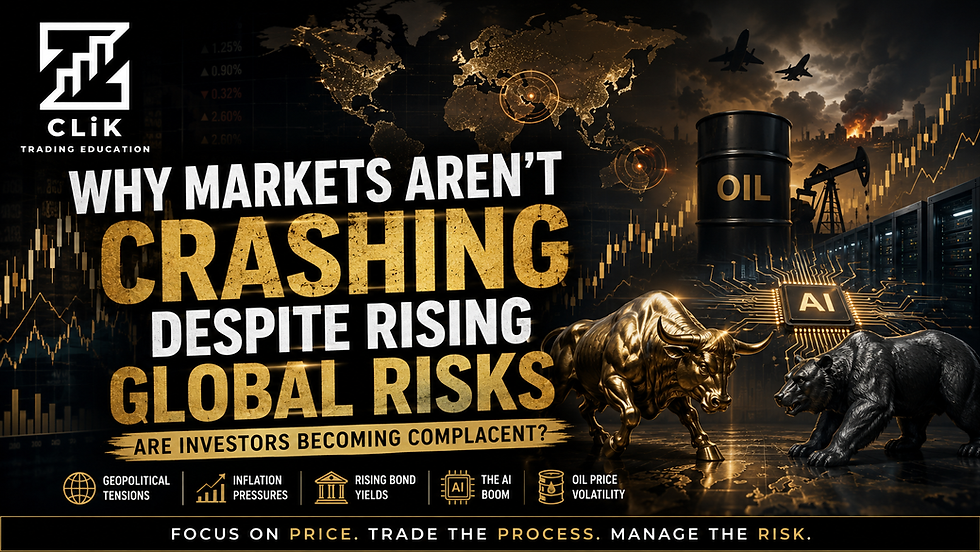
Why Markets Aren't Crashing Despite Rising Global Risks – Are Investors Becoming Complacent?
- Iftekhar Khan

- 1 day ago
- 4 min read
Oil prices are rising. Bond yields remain elevated. Inflation refuses to disappear completely. Geopolitical tensions continue to simmer. Yet global equity markets remain remarkably resilient.
For many traders, it feels as though markets are ignoring reality.
So what's actually happening?
More importantly, what lessons should traders take from it?
Markets Don't Trade the News – They Trade Expectations
One of the biggest misconceptions among newer traders is believing that bad news automatically causes markets to fall - global risks.
Professional traders understand something different.
Markets don't move because news is good or bad.
They move because reality differs from what investors were already expecting.
At the moment, markets are attempting to balance several competing forces:
Ongoing geopolitical tensions in the Middle East
Sticky inflation
Higher government borrowing
Massive investment into Artificial Intelligence
Expectations surrounding future interest rate decisions
Continued corporate earnings growth
Each factor pulls markets in different directions.
That is why price action often appears confusing.
The AI Boom Is Offsetting Much of the Fear
Artificial Intelligence remains one of the largest themes supporting global equity markets.
Companies continue investing billions into:
Data centres
Semiconductor production
Cloud infrastructure
Energy generation
Software development
The investment cycle has become so large that central banks are now monitoring whether AI borrowing itself could become a financial stability risk. The latest Financial Stability Report from the Bank of England highlights the rapid growth in AI-related debt financing and warns that current valuations depend on companies successfully delivering long-term earnings growth.
In simple terms:
Markets are betting that AI will generate enough productivity and profits to justify today's valuations.
That is a huge assumption.
Rising Bond Yields Are Sending a Different Message
While stock markets remain optimistic, bond markets appear more cautious.
Government borrowing continues to increase across most developed economies.
Higher debt levels mean governments must issue more bonds.
More supply generally requires higher yields to attract buyers.
At the same time:
Inflation remains above central bank targets.
Energy prices remain vulnerable to geopolitical events.
Markets are less certain about how quickly interest rates will fall.
This creates an unusual situation.
Stocks are pricing in optimism.
Bond markets are pricing in caution.
Eventually, one of them may need to adjust.
Oil Still Matters More Than Many Think
Every time geopolitical tensions rise, oil immediately becomes the centre of attention.
Higher oil prices don't just affect motorists.
They influence:
Transport costs
Manufacturing
Food prices
Inflation
Consumer spending
Corporate profit margins
Recent tensions have pushed Brent crude higher again, reminding investors that inflation risks have not disappeared. Reuters notes that oil prices have remained volatile as markets digest developments in the Middle East, while bond markets have reacted to the changing inflation outlook.
For central banks, this complicates interest rate decisions.
Tariffs Are Quietly Returning as an Inflation Driver
Another factor receiving less attention is tariffs.
Many businesses continue to pass higher import costs onto consumers.
Recent surveys suggest a significant proportion of manufacturers and service companies still intend to increase prices in response to tariff-related costs, even after earlier price rises.
This creates another challenge for central banks.
Lower inflation may take longer than many investors expected.
So Why Aren't Markets Falling?
Because markets rarely focus on one issue.
Instead, they constantly weigh probabilities.
Today the market appears to believe:
✅ AI investment will continue supporting earnings.
✅ Consumers remain relatively resilient.
✅ Labour markets have not deteriorated significantly.
✅ Central banks will eventually begin easing monetary policy.
Against that optimism sit several obvious risks:
Higher inflation
Rising energy prices
Expensive equity valuations
Geopolitical uncertainty
Increasing government debt
Neither side has fully won the argument.
That's why markets continue to grind higher while volatility remains beneath the surface.
Global Risks - What This Means for Traders
This environment highlights an important lesson.
Successful traders don't predict headlines.
They react to price.
At CLiK Trading Education, our methodology is built around identifying where supply and demand become imbalanced rather than trying to forecast economic news. Our structured process encourages traders to define the higher-timeframe context, assess trend, identify quality zones, score the opportunity and only trade when the probabilities align, rather than reacting emotionally to headlines.
News provides context.
Price determines decisions.
That distinction is one of the biggest differences between professional and novice traders.
Final Thoughts
Markets today are walking a tightrope.
Artificial Intelligence is providing enormous optimism.
At the same time, inflation, government debt, tariffs and geopolitical tensions continue pulling in the opposite direction.
Whether optimism or caution ultimately wins remains to be seen.
What is certain is that uncertainty itself creates opportunity—but only for traders with a defined process, disciplined risk management and the patience to wait for high-quality setups.
Because in financial markets, surviving uncertainty is often more important than predicting the future.
Disclaimer: This article is provided for educational purposes only and should not be considered financial or investment advice. Trading and investing involve risk, and past performance does not guarantee future results.

Comments